Nobody Can Read Your Mind - And That's Not Their Fault
.png "Nobody Can Read Your Mind – The Psychology Behind Unspoken Expectations")
My Personal Realization
Have you ever struggled to understand your friend’s emotions? They say, “I’m fine” or “I’m happy,” yet their replies sound irritated, distant, or cold. It leaves you wondering, do they need reassurance, or any help, or maybe a kinderjoy?
Or maybe you are that friend, the one who says “I’m okay” while secretly hoping someone will understand the emotions you cannot express out loud.
“I’m Fine” - The Two Words That Are Quietly Destroying Relationships
Here’s the uncomfortable truth nobody wants to admit: we expect the people we love to read our minds, and then we punish them silently when they can’t.
Until last year, I was that person. I’d sit quietly in the corner of my room, overwhelmed with emotions, wondering why nobody seemed to understand what I was feeling inside. It took me a long time to realize, I had never actually told them.
So why do we do this? Why do we stay silent and then feel hurt by the silence we created?
That’s exactly what this blog unpacks.
Why Do We Expect People To Read Our Mind?
Because deep down, we want to feel understood without having to explain ourselves.
For many of us, especially people pleasers, this pattern runs quietly in the background. People pleasers spend so much time understanding and emotionally supporting others that they start, unconsciously, expecting the same in return.
But asking for that support feels uncomfortable. Even selfish. Because their entire identity is built around being the “easy” one, the emotionally available one, the one who never needs anything.
(If you identify as a people pleaser, this pattern runs even deeper - read why people pleasers carry unspoken expectations without realizing it. )
Past experiences also shape these invisible expectations. Maybe there was a moment, your mother bringing you your favorite chocolate when you were upset, without you ever asking, that planted a seed: people who truly care just know. Without realizing it, that one experience quietly became a belief system you carry into every relationship.
And so the expectation lives on, unspoken, waiting to be disappointed.
The Real Reason We Stay Silent Instead of Saying What We Need
Many times, we feel angry at the people closest to us, without realizing we were silently expecting something from them that we never actually asked for.
And here’s where it gets even more complicated: in many of these situations, we ourselves are not even fully sure what we want.
We expect emotional understanding from others for feelings we haven’t fully understood in ourselves yet.
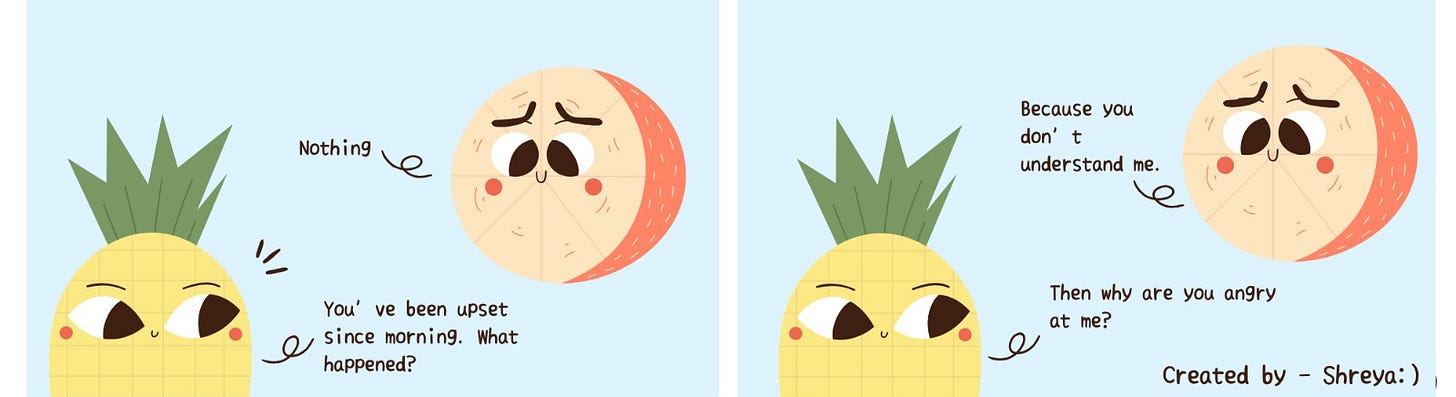
In situations like these, the frustration often goes deeper than simple miscommunication.
Think about the last time you were upset but couldn’t quite explain why. You just needed... something. Reassurance, maybe. Or space. Or someone to sit with you. But the feeling was blurry, tangled, hard to name, so you said nothing. And you hoped, somehow, the other person would figure it out.
That hope is where the frustration begins.
According to a 2017 study published in the Journal of Social and Personal Relationships, people in close relationships significantly overestimate how well their partners can understand their emotions without explicit communication, a phenomenon researchers call the "closeness-communication bias." The closer we feel to someone, the more we assume they can read us. Ironically, this assumption makes communication worse, not better.
Why Do People Hide Their Feelings?
Expressing our feelings requires vulnerability, self-clarity, and courage, and not everyone was taught how to do that safely.
Expressing emotions is not as simple as “speaking up.” It requires vulnerability, which means allowing someone to see the emotional, sensitive, or uncertain parts of us. It also requires self-clarity, because before explaining our emotions to others, we first need to understand what we are actually feeling ourselves.
Most importantly, emotional expression requires courage, because opening up always carries the possibility of being misunderstood, judged, ignored, or emotionally rejected.
For many people, emotional expression was never encouraged in a safe environment. Some grew up feeling judged for being “too emotional,” ignored when they tried to communicate, or misunderstood whenever they opened up. Over time, silence starts feeling safer than honesty.
Why Do Some People Keep Their Feelings Entirely to Themselves?
Keeping emotions inside can feel like protection, from judgment, from conflict, from rejection, from the terrifying possibility of losing a relationship that matters to you.
In the moment, silence feels like control.
But unexpressed emotions don’t disappear. They transform. They become overthinking at 2 AM. They become resentment that builds without a name. They become emotional exhaustion, passive distance, the slow feeling that nobody really knows you, even the people closest to you.
The irony is brutal: the silence meant to protect the relationship is often what slowly hollows it out.
When Expectations Replace Communication - The Trap Most People Don’t See
When we stay trapped inside our own assumptions, we slowly start loving our version of the story more than the actual person in front of us.
(This is also why unmet expectations are one of the biggest drivers of unhappiness - here’s how expectations directly shape your emotional state. )
This is where things get quietly dangerous.
When we become attached to our emotional expectations, when we start building an imaginary version of how someone should respond, how they should notice, how they should just know, we stop seeing the real person in front of us.
Having standards in relationships is healthy. That’s not the problem. The problem is when those standards become invisible tests that the other person doesn’t even know they’re taking.
We stop seeing them as a full human being with their own emotional world. And we start experiencing every unmet expectation as evidence that they don’t care, when in reality, they simply didn’t know.
The Hidden Loop - Why This Keeps Repeating
Most people don’t fall into this pattern once. They repeat it. Because it feels like a new problem every time, when it’s actually the same loop running on a different day.
It looks like this -
You don’t express → You expect others to understand anyway → They don’t → You feel hurt → You withdraw even more
It begins with silence, chosen because expressing yourself feels too vulnerable, too risky, or simply too unclear. But even without expressing yourself, a part of you still hopes the other person will notice. Will sense something. Will ask the right question.
They don’t. Not because they don’t care, but because they’re human, not psychic.
So the hurt sets in. And instead of saying “I’m hurt”, which would require the very vulnerability you were avoiding, you pull back further. You go quieter. You become a little more guarded. And the distance grows.
Over time, this loop doesn’t just create misunderstandings. It creates entire relationship dynamics built on silence, assumptions, and unspoken disappointment.
Breaking this pattern starts with one uncomfortable realization: people can support you better when you express yourself clearly, not when you silently hope they’ll figure it out on their own.
How To Break This Pattern - 5 Practical Steps That Actually Work
Breaking the loop doesn’t mean becoming emotionally perfect overnight. It starts with small, deliberate shifts.
1. Understand your own emotions before expecting others to understand them
Before looking outward, look inward. Ask yourself: What exactly am I feeling? What do I actually need right now, reassurance, help, space, or just someone to listen to?
Many relationship misunderstandings start because we expect others to solve an emotional equation we haven’t solved for ourselves yet.
2. Stop giving silent tests
If a thought like “if they really cared, they’d know” crosses your mind, catch it. That’s a silent test. And it’s designed to fail. Even emotionally intelligent, deeply caring people cannot reliably decode what was never said.
(If you find this step difficult, I’ve written on how to stop expecting too much from people with more practical techniques. )
3. Start expressing small things out loud
You don’t need to reveal everything at once. Start with small emotional honesty:
“I had a really rough day.”
“I think I need some reassurance right now.”
“Can we talk for a few minutes?”
These sentences feel small. But they build muscle. And slowly, they make honest communication feel less terrifying and more natural.
4. Separate the imaginary version from the real person
Notice when you’re relating to a version of someone that exists only in your head, the version that always says the right thing, always notices, always knows. Real people are messier than that. So are real relationships. And that’s not a failure. That’s just humanity.
5. Remember : communication doesn’t weaken relationships. It builds them.
The fear is that asking for what you need makes you seem needy, or weak, or too much. But the truth is the opposite. People who love you want to show up for you. They just need to know how.
Clarity isn’t clingy. It’s kind, to them, and to yourself.
My Wise Takeaway
Expecting people to read our minds comes from a genuinely beautiful place, the desire to be understood so completely that words feel unnecessary.
But real emotional connection isn’t built in silence. It’s built through honesty, through the willingness to say “this is what I’m feeling, and this is what I need”, even when that feels terrifyingly vulnerable.
I also realized something else along the way: not every emotional need has to become an expectation of another person. Sometimes, the first step is sitting with your own emotions long enough to actually understand them yourself.
Because when you understand yourself, you give others a real chance to understand you too.
At the end of the day, relationships become healthier when communication replaces assumptions, when we start seeing each other as human beings, not as emotional mind readers we’re waiting to disappoint us.
Love Love,
Shreya:)
Frequently Asked Questions
Q1: What is the first step to communicating emotional needs if I have never done it before?
Start with something small and low-stakes. Phrases like "I had a rough day" or "I need some reassurance right now" are enough to begin. Emotional honesty is a muscle, it gets stronger with small, consistent use, and it does not require a big vulnerable conversation on day one.
Q2: Why do I find it so hard to say what I need from people?
Expressing emotional needs requires three things most people were never taught: vulnerability, self-clarity, and courage. If past experiences taught you that opening up led to judgment or dismissal, your mind learned that silence is safer. That is a learned adaptation, not a character flaw.
Q3: Why do I get angry at people even when they haven’t done anything wrong?
Often this anger is really disappointment from an unmet silent expectation. You expected something, reassurance, acknowledgment, a specific response, without asking for it. When it did not happen, the frustration had nowhere to go except outward. Recognizing this pattern is the first step to breaking it.
Q4: Why do I expect people to understand me without telling them how I feel?
This usually stems from the "closeness-communication bias", the closer you feel to someone, the more you unconsciously assume they can read your emotions. It often also traces back to early experiences where someone (a parent, a close friend) understood your needs intuitively, creating a belief that people who truly care should just know.
%20(1).png)
%20(1).png)
.jpg)
Comments
Post a Comment